

Structural geology is not dead: reflections from a walk through central Australia

Updated: Jul 7, 2024
In mineral exploration, you’ll often hear the refrain “structure is king”. Most orebodies have a structural control, either in terms of the intersection of structures that have produced favourable sites for precipitation of hydrothermal mineralisation, or as post-mineral reworking that can translate an orebody or alteration system in space, potentially confounding attempts aimed at near mine exploration and extension of orebody along the line of lode.
Picking the different phases of deformation and placing them into a sequence of events that reflect the changes in rheology due to temperature, strain and strain rate is an important element in understanding how rock masses have evolved over time. And that after all is the purpose of geological observation. It is perhaps a surprise that many geologists seem to find structural geology either difficult at best, or completely unintelligible at worst.
For me, although I’m not the best at structural geology, description of a rock's structural elements is intimately coupled with the basic rock description. If the rock has a tectonic foliation, the mineralogy, style and orientation of that foliation is important. In fact, it is critical to observe and record these features as part of any geological investigation.

Larapinta reflections
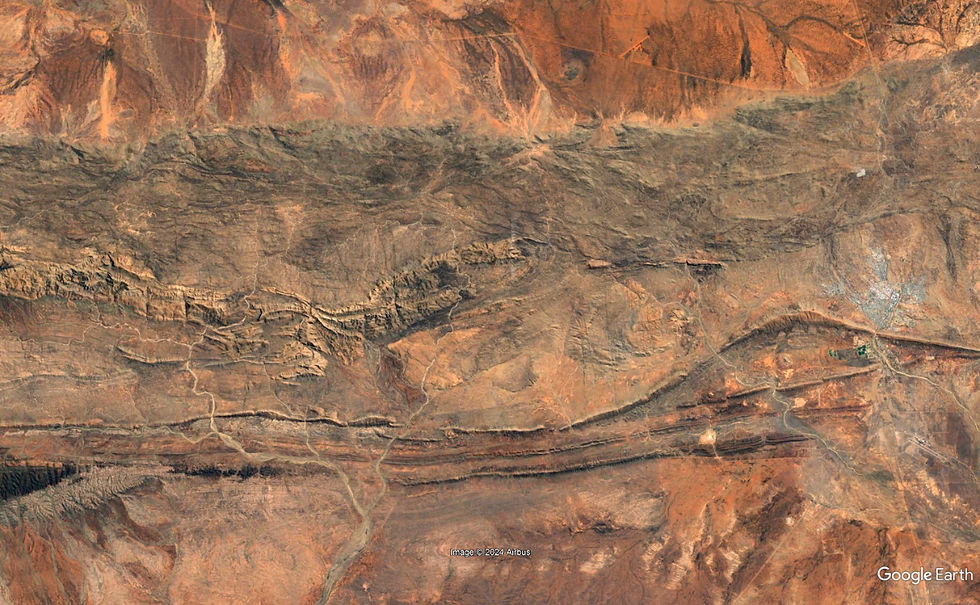
Recently I had the great fortune of trekking along part of the famous Larapinta Trail, through central Australia with my partner, Kate. The trail strikes out westwards from the wonderful town of Alice Springs. Personally I think The Alice, M'parntwe, is one of the most beautiful cities in the country in terms of its geography. The town is nestled up against the Heavitree Range and contains beautiful outcrops of Paleoproterozoic granitic gneiss right in the centre of town.
On the trail, after trudging through the knee high buffel grass that cloaks the creek lines surrounding the 1880s vintage Old Telegraph Station, crossing the Stuart Highway and then the north-south railway line, I was soon faced with some wonderful uphill waking all the while enjoying boulders of augen gneiss and muscovite-rich pegmatites.

Ductile structure
Pretty soon that gneissic fabric gave way to a most satisfying mylonite texture. The intensity of the foliation was breath-taking. The K-feldspar augen reduced to smears within a nearly perfectly smooth tectonic foliation with very little evidence for asymmetric fabric elements that might hint at the kinematic history of this shear zone. The down-dip mineral elongation lineation was similarly obvious, and if I had more time I think I might have been able to find out if the movement on this shear zone was either thrusting or extensional. Regardless, the shear zone marked a clear transition from a zone where deformation formed a pervasive gneissic fabric to one in which strain was concentrated into an intense zone of shear, probably at shallower crustal levels and possibly some considerable difference in time between these two fabric forming events.
I’m not here to give you a detailed geological history of central Australia - that you will find in many other publications. I just want to say that already, on the first morning of walking the Larapinta, I understood that this region has a complex structural history and I was excited for what was to come as the trail wound it’s way west.

Ductile structures like the shear zones I was walking through are impressive. They represent zones into which plate tectonics have concentrated the effects of slab push and ridge pull - stresses that may have propagated across hundreds of kilometres of crust find release in the recrystallisation, reorientation, and slippage of minerals and the formation of entirely new rock fabrics. In another zone of shear that I saw as I crossed the Alice Valley walking towards Ellery Creek, I stopped to inspect the rocks again and look for kinematic indicators. Between you and me, kinematic indicator spotting is actually one of my favourite pastimes. I love the challenge of scouring the rock mass for the subtle hints of asymmetry in the recrystallised tails of porphyroclasts, the various types of C and S foliations, and other elements that make up Reidel fabrics. These structural elements are little indications of the dynamic flow of rock mass, and it’s wonderful to visualise how the rock was once ductile enough to flow, albeit slowly, absorbing the great stresses that build mountains or pull apart continents.
In the Ellery Creek itself I found a beautiful pavement outcrop of north-dipping (~80degrees) felsic gneiss with a subtle down-dip mineral elongation. Looking at the plane parallel to the lineation but perpendicular to the foliation, I ran my eyes across the rock mass looking for those tell tale signs of flow. And I was surprised. In this case I could see a range of delta-type porphyroclasts and a beautiful domino-boudin structure in a large, elongated feldspar coast that suggested north side down, and therefore in the current coordinates, extensional movement within this shear zone at this location at least.
Reliably interpreting kinematic indicators requires that you see a lot of them, as many as you can anyway, and that you get an overall sample of the asymmetry of the shear fabric. You can’t be satisfied with just a few of you really want to map out the kinematic evolution of a shear zone. On top that statistical approach to defining the kinematics of a shear zone it’s important to remember that of one portion of a shear zone was flowing with less speed than an adjacent portion, then an apparent contraction in kinematic indicators - extensional and compressional - can result (see Bhattacharya, 2022 for example).

Still, I have to say, an extensional shear zone was not what I expected to find and it's an exciting thing to see. Thrusting is a common structural style in the region (Collins and Teyssier, 1989) although extensional shear zones are also described so not entirely unexpected (James and Ding, 1988). I found that very interesting to think about when the apparent extensional deformation might have occurred relative to either the several Proterozoic or Paleozoic events that have affected the region.
Perhaps I was looking at a shear zone that resulted in exhumation of Paleoproterozoic rocks and associated low pressure, high temperature metamorphism during the Paleoproterozoic. Or was this ductile fabric a response to basin formation during the extension that must have occurred in the central Australian crust to accommodate deposition of vast sedimentary rocks within the Amadeus Basin from at least c. 820 Ma through to c. 440 Ma? I don't know the answer unfortunately, but these kinematic indicators really set me wondering!
Brittle and brittle-ductile structure
I also saw a lot of great examples of deformation features formed in the brittle and brittle-ductile regime. I’ll give you two examples before I wind this up. The first is a small-scale duplex structure that shows how deformation is partitioned into weak zones while more competent rocks can remain relatively unaffected. This particular duplex was in Paleoproterozoic quartzite and I spotted this in the beautiful landscape of Spring Creek gorge. Steeply dipping quartzite beds show ramping of small-scale thrust faults that suggested the northern side was pushed upwards over the southern. Duplex structures have often fascinated me since I saw them a lot in the field in eastern Tibet within the Jinsha Jiang Suture Zone. I remember those serpentinised ultramafic bodies that record the Permo-Triassic suturing of the Qiangtang Terrane to the Yidun Arc very well (Reid et al. 2005)!

A second fabulous structure I noticed on our way through Hugh Gorge. This tremendous incision into the same Paleoproterozoic quartzite has exposed a wonderful strike perpendicular section through a zone of intense deformation. Walking ahead of my little walking party I looked to the eastern wall of the gorge and exclaimed with what was probably too much enthusiasm for my non-geological friends when I saw the textbook example of a fault-propagation fold in the rock. A ghost gum has grown out of the axial plane of the fold, forming a beautiful interaction between geology and biology.

Reflections
So as I munched on my muesli with powdered milk each morning, I marvelled at the forces of nature that manifest in the structural geology of the rocks beneath our feet. And I wondered why structural geology was always considered difficult by some geologists, and perhaps even irrelevant by others.
Structural geology is far from dead. In fact, it’s needed now more than ever.
I wondered if our collective ability to fill spreadsheets with numbers that describe rocks in terms of chemistry or physics has become the default way of observing them. Whether a geochemist who plots with diligence the ratios of various high field strength elements or looks for trends and “vectors” towards mineralisation; or a geophysicist who views rocks as either “granite or not granite” or worse perhaps simply as high or low [insert physical property here], I think it’s fair to say that any one of these aspects can only tell us so much about the overall system within which the rock package we are concerned about has evolved.
That is where structural geology can have a major impact.
The geometry and orientation of structures in relation to petrographic observation can have profound implications for understanding crustal depth changes recorded in rock packages that are now at or near the surface. When coupled with geochronology of appropriate minerals and an understanding of metamorphic processes that also respond to tectonic regimes, structural geology is our best way to understand crustal evolution through time and can play a major role in both understanding mineral potential conceptually, as well as at the practical level of drill hole targeting.
My conclusion? More structural geology, please.
But as always, integration with multiple datasets is key.
Acknowledgements
Thank you to my partner Kate for getting me out onto the trail and to the people who helped us get there and walked with us.
The Larapinta Trail is on Arrernte country in central Australia and I acknowledge the enormous contribution to Australian life and culture by Arrernte people despite the cruel hand history has played them. May their aspirations for health, wealth and cultural integrity be realised.
Annette Weisheit and the Geological Society of Australia have published an amazingly user friendly guide to the geology of the Larapinta trail, which I enjoyed reading very much. Thank you Annette for your dedication to sharing the geology of the region with the non-specialist - this is very important work.


Comments