

On the rocks: conductivity and Archean gneisses

Updated: Aug 10, 2023
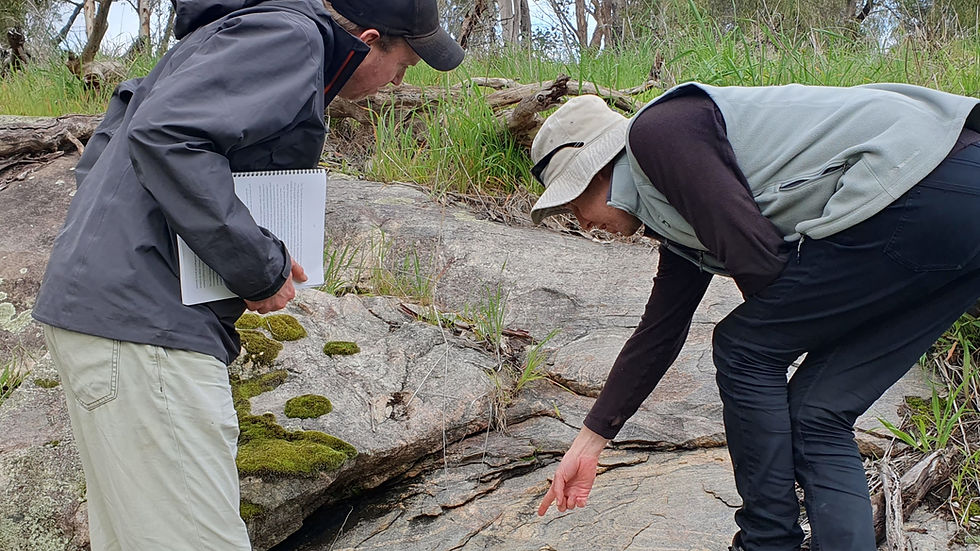
A geophysicist, a petrologist and a geochronologist walk onto a rock outcrop...
It sounds like the setup for a geeky geoscience joke doesn't it?! But it wasn't a joke, it was a brilliant day of geology.
I was in Perth for the 6th International Archean Symposium and Target 23, two amazing conferences that saturated me in new geoscience knowledge. Two of my geoscience friends in Perth, Dr Kate Selway and Dr Dave Kelsey, kindly offered to take me to see some of the local geology on the Saturday after the events. And so the set up line became a reality.
A truly inspiring day of connecting with some of the amazing geology of the world famous Yilgarn Craton. What did we see on that slightly drizzly day? Let me share a couple of ideas we talked about as we looked at meta-igneous and metasedimentary gneisses dating from over 2,660 million years ago.
Gneissic fabric and conductivity
If you don't already know Dr Kate Selway, let me just say, if you ever get the chance to talk with her, you should. She's an effortless communicator and makes complicated concepts easy to understand.
Dr Kate is an internationally renowned specialist in the field of magnetotellurics geophysical method for investigating the natural conductivity of rocks in the subsurface. Check out Dr Kate's geohug talk or this one for the ASEG to get to know more.
Magnetotelluric data suggest that rocks can and do conduct electricity to varying extent. Let me clarify that. For the most part rocks are not good at conducting electrical current. But in some circumstances and if they contain some particular minerals as minor phases, they can be conductive.
Magnetotelluric instruments can image very deeply into the Earth, with the right settings, well into the asthenosphere. This gives geophysicists a remarkable window into the properties and architecture of the entire lithosphere and the method has been applied the world over to understand the structure and evolution of the continents. It has also been applied to look for signatures of geological processes such as ancient fluid flow that may have formed ore deposits. You may have seen images like this one before:

Sometimes you will see magnetotelluric sections like this and the authors will interpret some zones of elevated conductivity as being shear zones.
This has always fascinated me since we often see shear zones in rocks at the surface and the idea that we can project downwards from a surface exposure to trace where a shear zone goes to at depth is very appealing. We can use magnetotelluric models to image if shear zones are large or small, if they dip or if they don't.
So, as we were looking at the wonderful Archean gneisses of the western Yilgarn Craton, we spotted this rock fabric:
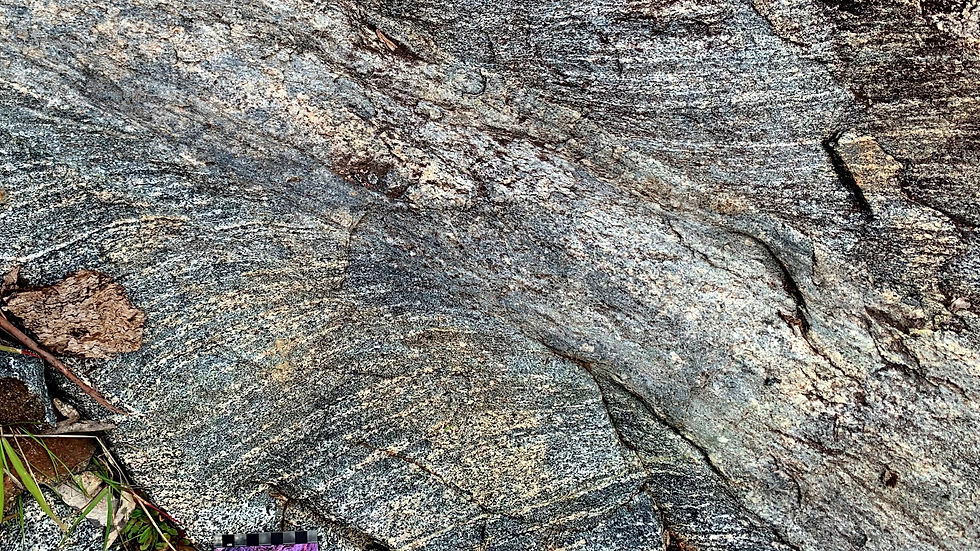
You can see that the rock has a gneissic fabric defined by variation in quartz, feldspar and biotite that is dragged into a zone of higher strain which overprints the gneissic fabric and dips to the right in the field of view. This is a classic example of a ductile shear zone, with an apparent right lateral offset.
But if we imagine this on a scale of hundreds of meters or even kilometres would a
shear zone like this be conductive enough to show up in a magnetotelluric survey Dr Dave and I asked Kate. Her answer?
No.
There is nothing in a rock fabric like this that is conductive. Since this type of ductile shear zone is what conductive zones in magnetotelluric data have been interpreted in this way, I was curious in what Kate meant.
"To make the crust conductive you need conductive minerals like graphite or sulphides in the rocks. Minerals like phlogopite, a Mg-rich biotite, can also be conductive but they need to be at elevated temperatures, over 500 degrees."
Typical Archean quartzo-feldspathic gneiss like the one we were standing on was clearly not going to conduct electrical currents. And while phlogopite might possibly be more abundant than graphite or sulphides, rocks don't reach 500 degrees until well into the upper mantle under a geothermal gradient in a stable cratonic environment.
So what is causing crustal conductivity?
"It might be that thin films of graphite can persist at high pressures and temperatures in the crust, in ways that are not possible in the shallow crust". Dr Kate explained that nano-scale films of graphite or tiny nanoscale particles of sulphide could potentially enhance electrical conductivity, even in otherwise resistive rocks.

There are a lot of ways to get carbon into rocks and the mantle itself is thought to have on the order of 30 parts per million carbon. Processes like partial melting or subduction and associated metasomatism of the mantle can increase this and these changes in composition could be linked to mobilisation of carbon through the lithosphere.
Possibly into shear zones.
"Not every conductivity anomaly is carbon." Dr Kate explained. But some may be. In any case the difficulty of interpreting magnetotelluric data lies in its non-uniqueness. Like all geophysical methods, a good interpretation means considering the geological context, the timing of various processes and the integration of as many other datasets as possible.
It was time to get to the next outcrop so we piled back into the car and headed out. More high temperature rocks awaited us at the next stop.


Comments