

Machine learning for data discovery

Updated: Jun 6, 2023
Scrolling. Page by page. Skimming through handwritten or typed exploration reports. Urgh. The RSI in my right index finger flares up if I even so much as download a large report in anticipation of the scrolling marathon that is about to ensue.
But it needn't be so, with a bit of help from everybody's new best friend, machine learning and artificial intelligence.
Not that I want to jump on any bandwagons here, and I'm not being paid to say this. I just find it really interesting to see what the team at Radixplore have put together. Their propriety AI-driven platform enables searching through vast troves of publicly available unstructured data in exploration reports, including things like thin section descriptions and even hand written drill logs.
Looking for apatite in unstructured data
On the back of a previous post about iron oxide-apatite deposits and their potential for rare earth elements, I got talking with Russell Menezes from Radixplore about searching for magnetite and apatite in Australia.
I'll leave it to Radixplore to talk about the mechanics of all this, for now I just want to show you a look at the results of a very quick search that he and I did using their database.
Here's a map of Australia. It's a heat map showing the location of exploration reports that contain the words "magnetite", "apatite" and "coarse grained". The database only searches the WA, NT, SA and NSW data at this stage, but nevertheless, it's an interesting result.

To qualify all of this, the phrase "coarse grained" could apply to any mineral and not necessarily apatite in many petrographic descriptions. We account for this by searching for the phrase "coarse grained apatite" and then applying a phrase expansion technique so the authors could have expressed that phrase differently. So, phrases like "The apatite contained coarse grained crystals" will also be picked up in the search. The heatmaps include these expanded phrase searches so the coarse grained term is related to the apatite.
A coarse grained mafic rock that contains magnetite and apatite may have been picked up in this first pass search. This might be what is being included in the case of the two small blue zones in central Australia (southern NT), but I really want to follow these up...
I'm also really curious about the hot zones in WA, in the Yilgarn Craton. Are there coarse grained apatite-bearing rocks in the Yilgarn? I guess the search is picking up mafic rocks, but would love to have time to zoom in on this area and have a closer look. Magnetite alteration perhaps?
Let's take a look at the SA portion, a place I know a bit more about. By zooming in a bit the heat map becomes a little less blurry and I've added a few region names that might help those of you familiar with SA geology place the hot zones.
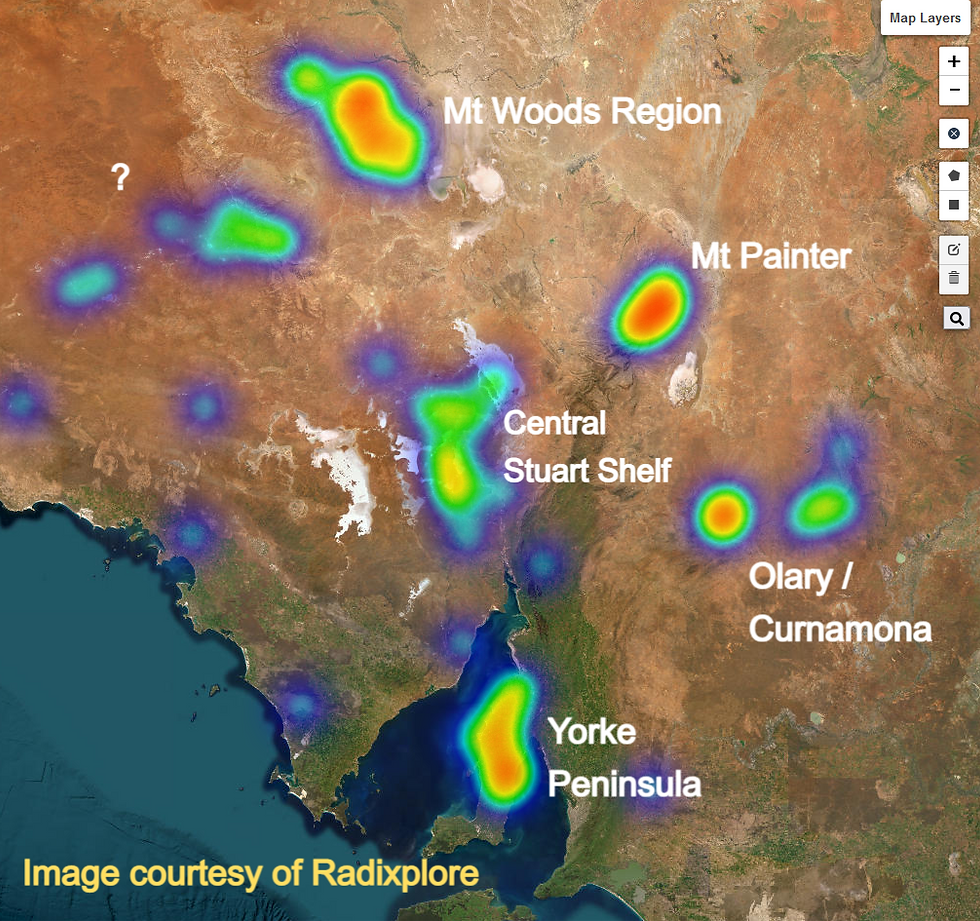
I find this a really interesting map because if you had asked me where to look for IOA deposits, I would have said try the Mt Woods region for starters, because there are a lot of magnetite-rich rocks, some of which are apatite-bearing such as at the Cairn Hill magnetite deposit.
The central Stuart Shelf region and the Yorke Peninsula are also regions with crystalline basement that is part of the Olympic iron oxide-copper-gold province. Apatite is a well known accessory mineral in IOCG systems, so we would predict that the database should show a correlation between the magnetite-rich endmembers of the IOCG alteration system and the word apatite. The heat map shows where to focus follow up reading.
As for the rest of the region, Mt Painter is known for it's unusual minerals but I'm not sure what is showing up here? And what about the Curnamona Province area? Is there really something significant in the region to the south-west of the Mt Woods region? Also, should we be checking out the single point 'anomalies' in the western Gawler Craton region?
Data discovery
You could do these searches with any type of deposit model in mind and see what you get using it as a data discovery tool. I'll be giving it a go in my work with clients for sure.
Using the computer to do the scrolling is a major advance as any combination of search phrases can bring out the different aspects of the geology of the search space. With the tool, you can click through very quickly to skim directly to the key points and this enables the geologist to filter the search.
Of course, you still need to understand geology to make sense of the results. We haven't managed to automate that yet.


Comments