


Discoveries in the Tasmanides: fertile rock systems, great datasets, and multicommodity potential

Impressive! I love conferences. They are fantastic for catching up with colleagues and making new connections. You really can’t beat the opportunity to listen to world experts discuss their exploration and geology projects - it bring geology to life, like a great celebration of science and exploration.
Talking shop is a great way to glean new insights and also a great way to discover what you know and what you don’t know when you’re asked about your own project work. It’s fantastic to have probing questions that help you to be a better scientist and commutator. I relish those opportunities.
At the start of September 2024 I was fortunate to attend Discoveries in the Tasmanides, a two day conference held this year in Albury, NSW. I was there with small group from Fleet Space Technologies, along with over 300 delegates from across the exploration industry.
Exploring for gold
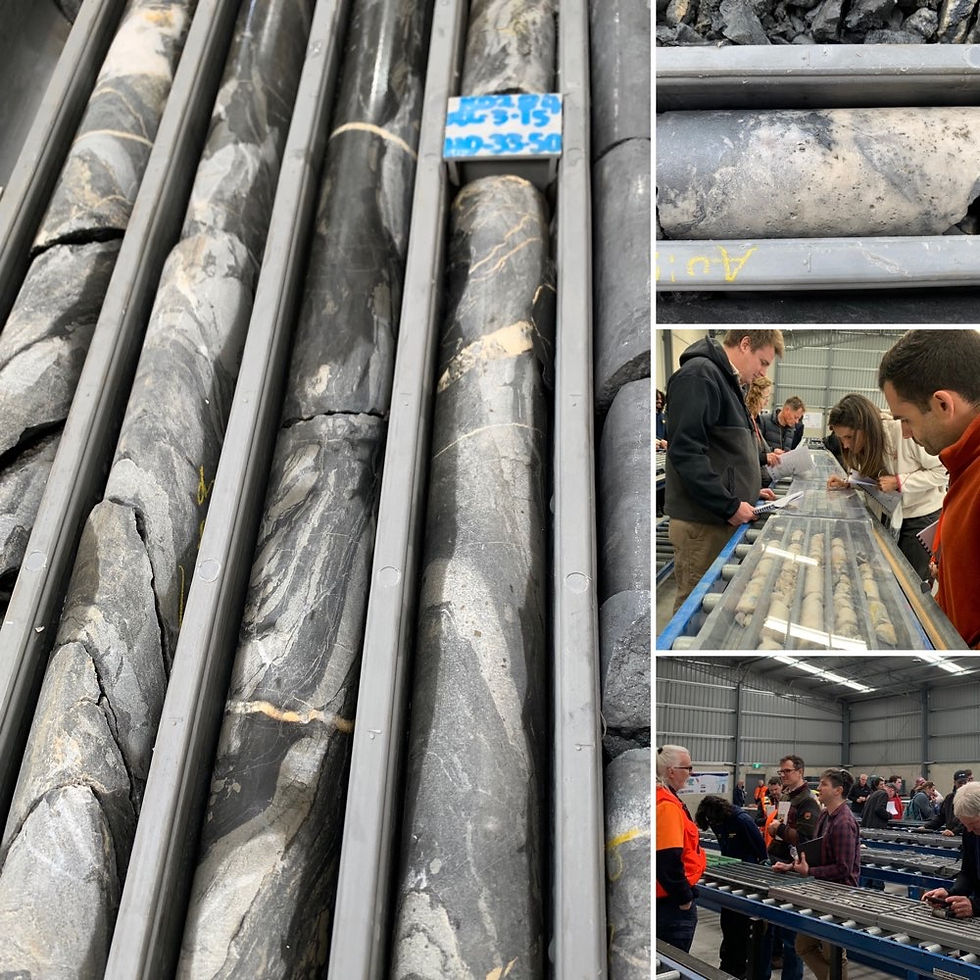
The pre-conference field trip involved a traverse across Victoria and provided an opportunity to view drill core from some of the region’s orogenic gold deposits, including the world class Fosterville deposit. Visible gold, quartz veining and related sulphide-bearing alteration was clearly evident in the core and a topic of discussion for the Fleet geologists was to consider what the possible velocity response would be of these features in ambient noise tomography.

The structural control of these orogenic gold deposits means fluid flow is highly concentrated into key, typically second order structures. ANT is highly sensitive to changes in rock properties and can image steep structures with fidelity as a result of the range of frequencies sampled by the method. While small structures and deposits are unlikely to be detected with a wide spaced sensor array, if the structures have seen significant fluid flow and deformation the velocity response is likely detectable. The architecture and footprint of a large mineral system is likely something that ANT would detect, even if the specific structures that host mineralisation are at a smaller scale than can be directly imaged.
Tasmanide geology
District to deposit scale exploration outcomes
The Tasmanides encompass the eastern third of the Australian continent and represent the accreted terranes develops in relation to prolonged, generally east dipping subduction that operated at the Pacific margin of Australia since the Cambrian. The range of geological terranes in the region reflects the complexity of the subduction system, with preserved tracts of various of accretionary wedge, fore arc, arc and back arc preserved in what is now a complex, polydeformed piece of lithosphere that is best viewed as an extensional accretionary orogen.
Regional geology talks which attempted to synthesise the geological evolution were well received, with Ross Cayley, Gideon Rosenbaum and Karen Conors all providing evidence for the complex behaviour of this system through time. The importance of lithospheric architecture and the deep crustal substrate in the mineral systems was highlighted, with the best example coming from the reflection seismic evidence for a highly imbricated stack of oceanic crust in the mid- to lower crust beneath the Bendigo Zone in Victoria as the key source region for the abundance of world class gold deposits in the region.
Inflection Resources’ CEO Doug Menzies, a legend of Tasmanide exploration, gave a great talk showcasing the company’s work on their Dick Creek project area. Since I have had a lot of interaction with the Inflection team on this project it was great to see Doug also provide an overview of the use ANT in their workflow. I’m working on a paper with the team that discusses the results from a district-scale ANT survey right at the moment! Waratah Resources also showcased their Fleet Space ANT results, which has tantalising areas for follow up that combines nicely with other geophysical data and geochemistry.

Magmatic hydrothermal processes were also well represented in talks by companies with numerous examples of porphyry, epithermal and iron oxide copper-gold projects. The talk by Scott Halley, Australian geochemistry expert, explored the importance of the repeatable and understandable geochemical haloes that develop above and around porphyry-epithermal deposits. Urging explorers to utilise the low detection limits provided by modern ICPM analysis, Scott Halley showed that above the key deposits, a gradation from high to low temperature alteration is expressed in the trace metal systematics with deeper, hotter parts of the systems enriched in elements like molybdenum while the outflow zones are typically enriched in antimony and cerium. The importance of even widely spaced geochemistry in its ability to highlight large scale fluid systems was a key takeaway from his talk.
Some important figures from Scott Halley’s talk are provided in the Australian Institute of Geoscientists’ Bulletin 76 which is an abstract volume for the conference. It’s well worth a read and has some great articles and images.

For the Fleet team, this generated a lot of discussion. There are significant parallels between the application of widely spaced geochemistry and the roll out of district-scale geophysical surveys using Fleet’s Exosphere ANT. The aim of both these complementary methods is to identify the large footprint of fossil hydrothermal systems and enable the scale reduction process in an efficient manner.
Many other projects were also highlighted during the conference ranging from orogenic gold, mafic and ultramafic nickel-copper-cobalt, through to rare earth element systems in the regolith. The high quality of the talks meant there plenty of learning on offer and for our geological team in particular, the opportunity to see and discuss the rock associations and textures across such a wide variety of deposit styles was energising. Since a large part of the team’s job requires interpretation of geophysical models, continually broadening their geological knowledge via an event like Discoveries in the Tasmanides means they are well placed to weigh up geological reality when assessing geophysical models.
Congratulations to the organisers for an impressive event! I’m keen to go back next year and see what’s new in exploration across either eastern third of the Australian continent.


Comments